

How AI Is Transforming Gratitude Journaling in 2026
Discover 4 ways AI is revolutionizing gratitude journals: personalized comic illustrations, mood tracking, smart affirmations, and visual manifestation.
Still writing your gratitude journal in a blank notebook?
In 2026, AI is quietly transforming how millions of people journal. It's no longer just about recording what you're thankful for, it's about seeing your gratitude, understanding your emotional patterns, and reinforcing positive thinking through intelligent, personalized feedback.
This isn't science fiction. It's already here.
This article breaks down exactly how AI is reshaping the gratitude journaling experience, and why 2026 might be the perfect time to make the switch.
What's the Difference Between Traditional and AI Gratitude Journals?
Here's a straightforward comparison:
| Aspect | Traditional Journal | AI Gratitude Journal |
|---|---|---|
| Recording | Handwriting or typing | Type text, AI generates illustrations |
| Mood tracking | Manual self-reflection | Automatic emotion trend analysis |
| Affirmations | Generic, self-sourced | AI-generated based on your daily entries |
| Review experience | Scrolling through text | Gallery, calendar, and timeline visual modes |
| Motivation | Willpower alone | Streak tracking, fresh daily artwork |
| Community | Solo practice | Gratitude Universe public feed, hearts and comments |
The key isn't that one is "better", it's that AI solves the biggest pain point of traditional journaling: consistency.
Research suggests roughly 80% of people abandon their journaling habit within the first two weeks. The top reason? Feeling like what they wrote "wasn't meaningful enough", no immediate feedback, no sense of reward. AI gratitude journals solve this by delivering instant visual feedback that turns every entry into a satisfying, tangible experience.
What Are the 4 Revolutionary AI Applications in Gratitude Journaling?
1. Personalized Four-Panel Comic Illustrations
This is the most groundbreaking feature of AI-powered gratitude journals.
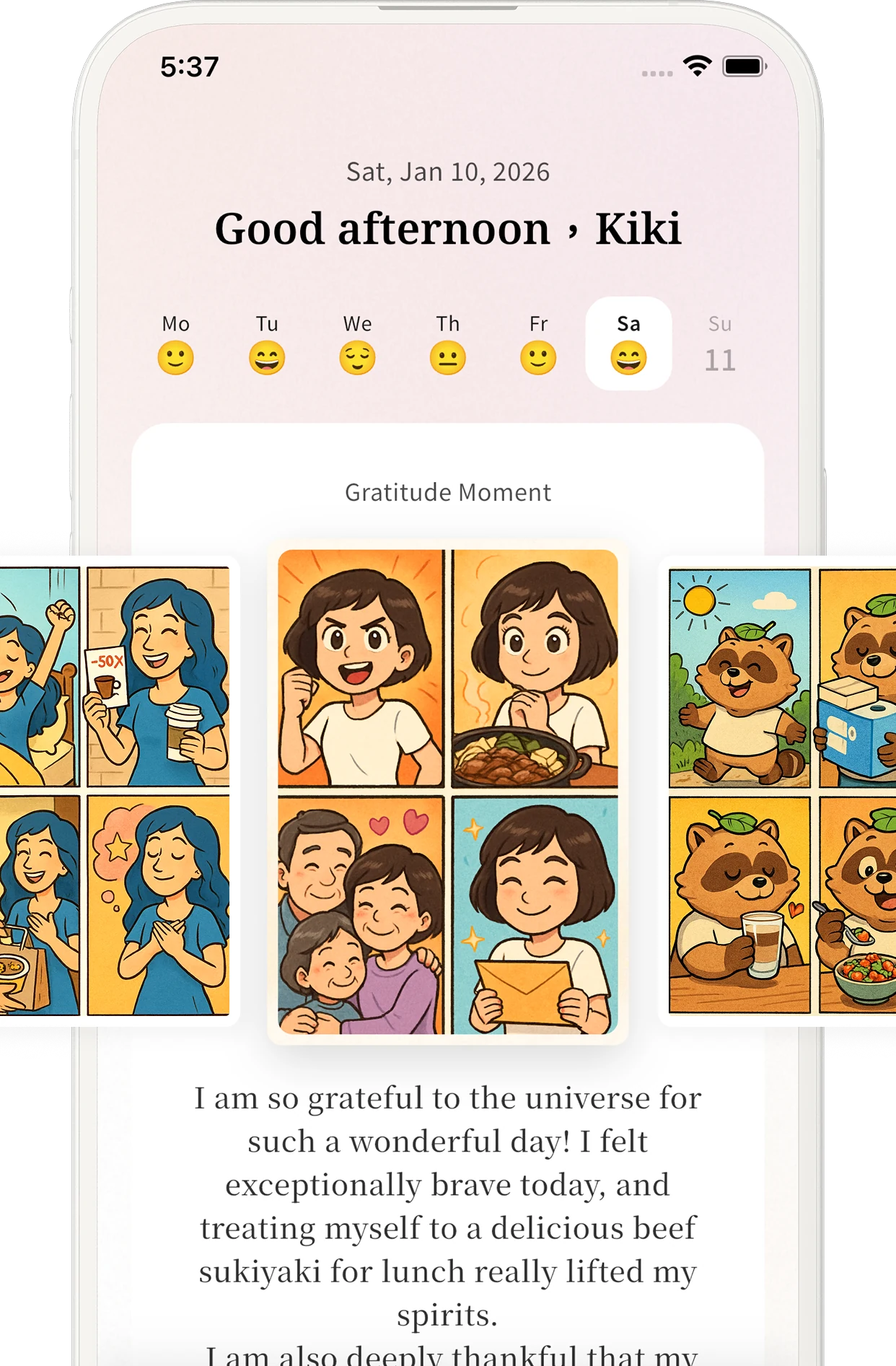
Traditionally, when you write "I'm grateful my family enjoyed hot pot together tonight," it's just a line of text. In an AI gratitude journal, that sentence transforms into a personalized four-panel comic strip, featuring you (or your custom avatar) in the scene you described. This way of turning gratitude into illustrations gives every entry a vivid, memorable form.
Why does this matter so much?
Psychologist Allan Paivio's Dual Coding Theory demonstrates that when information is presented in both verbal and visual formats, the brain creates two independent memory pathways. The result? Memory retention that's 6 times stronger than text alone.
Your gratitude isn't just words anymore, it's a vivid scene you can revisit and re-experience. Every time you see that illustration, your brain re-activates the warm feelings of that grateful moment.
hana - Gratitude Journal pioneered this approach: enter four gratitude or manifestation statements and get a healing-style personalized four-panel illustration based on your unique avatar, giving your words instant visual power.
2. Mood Tracking and Emotional Analytics
Do you know what your average mood was this week? Last week? Last month?
Most people have no idea what their emotional patterns actually look like. We think we're "always stressed," but data might reveal that 60% of your days were actually positive, you just remember the bad ones more vividly (thanks to negativity bias).
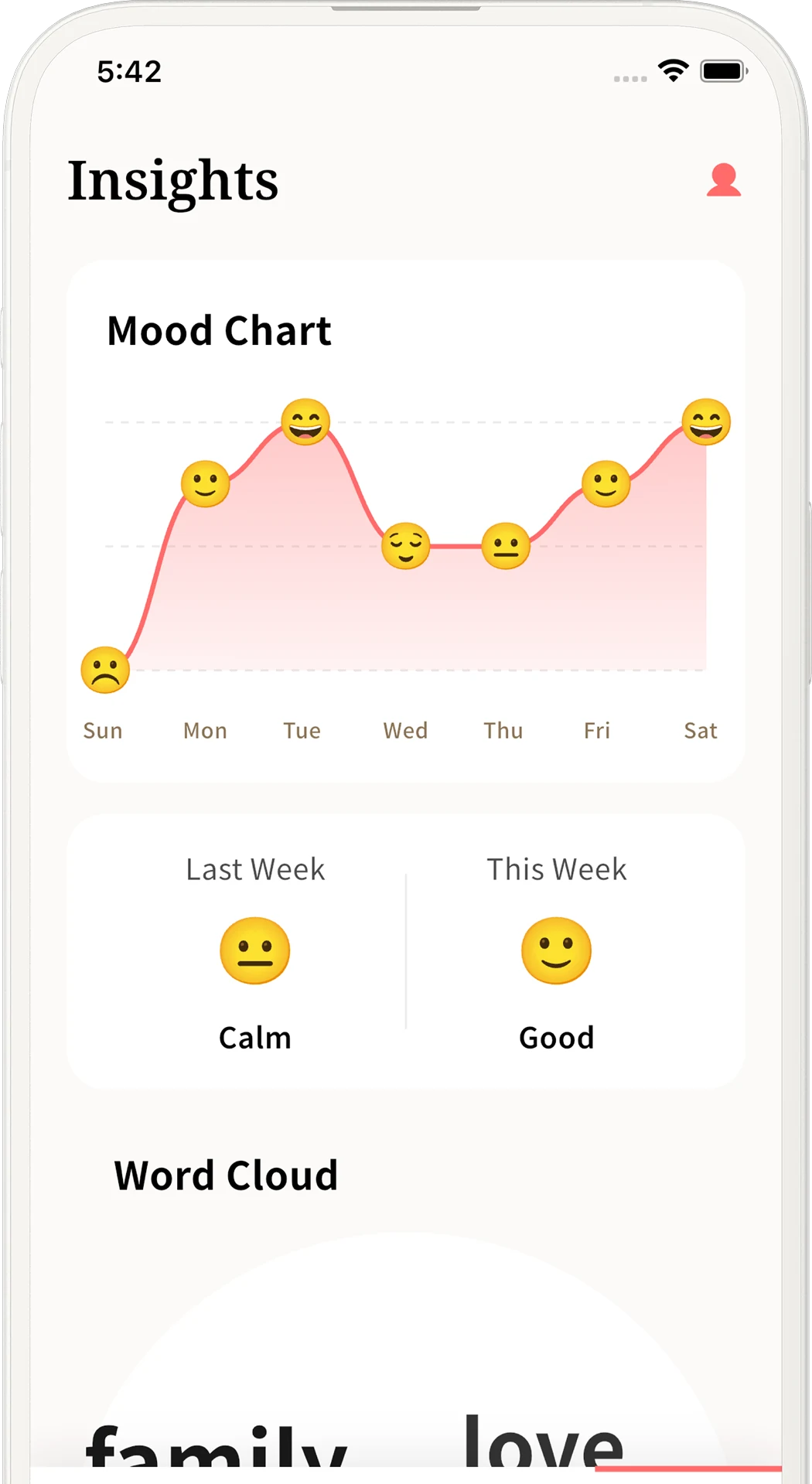
AI gratitude journals now include mood tracking capabilities:
- Daily mood recording: quickly log how you feel using expressive emoji moods
- Mood trend charts: visualize your emotional ups and downs over time
- Weekly/monthly comparisons: spot patterns you'd never notice otherwise
- Word cloud analysis: AI identifies the keywords that appear most in your journal, revealing what truly matters to you
This isn't just logging, it's a self-awareness engine. When you can see your emotional patterns, you gain the power to consciously shift them.
3. Smart, Personalized Affirmation Generation
Affirmations are one of the most well-researched techniques in positive psychology. But here's the problem: most people use generic ones.
"I am worthy." "I deserve love." These are fine, but they lack personal resonance.
AI gratitude journals take a different approach: they generate affirmations based on what you actually wrote that day.
Example: If today's journal mentions "grateful my boss recognized my proposal," the AI might generate: "My creativity and effort are always seen. I'm proud of my professional abilities."
This level of personalization creates far stronger emotional resonance than generic affirmations, because it's directly tied to your real experience today.
4. The Visual Manifestation Loop
Combining the previous three features, AI gratitude journals create a powerful closed loop:
- Write gratitude → AI generates a four-panel comic (visualize your gratitude)
- Log your mood → AI tracks emotional trends (understand your patterns)
- Receive affirmations → AI generates personalized affirmations (reinforce positive beliefs)
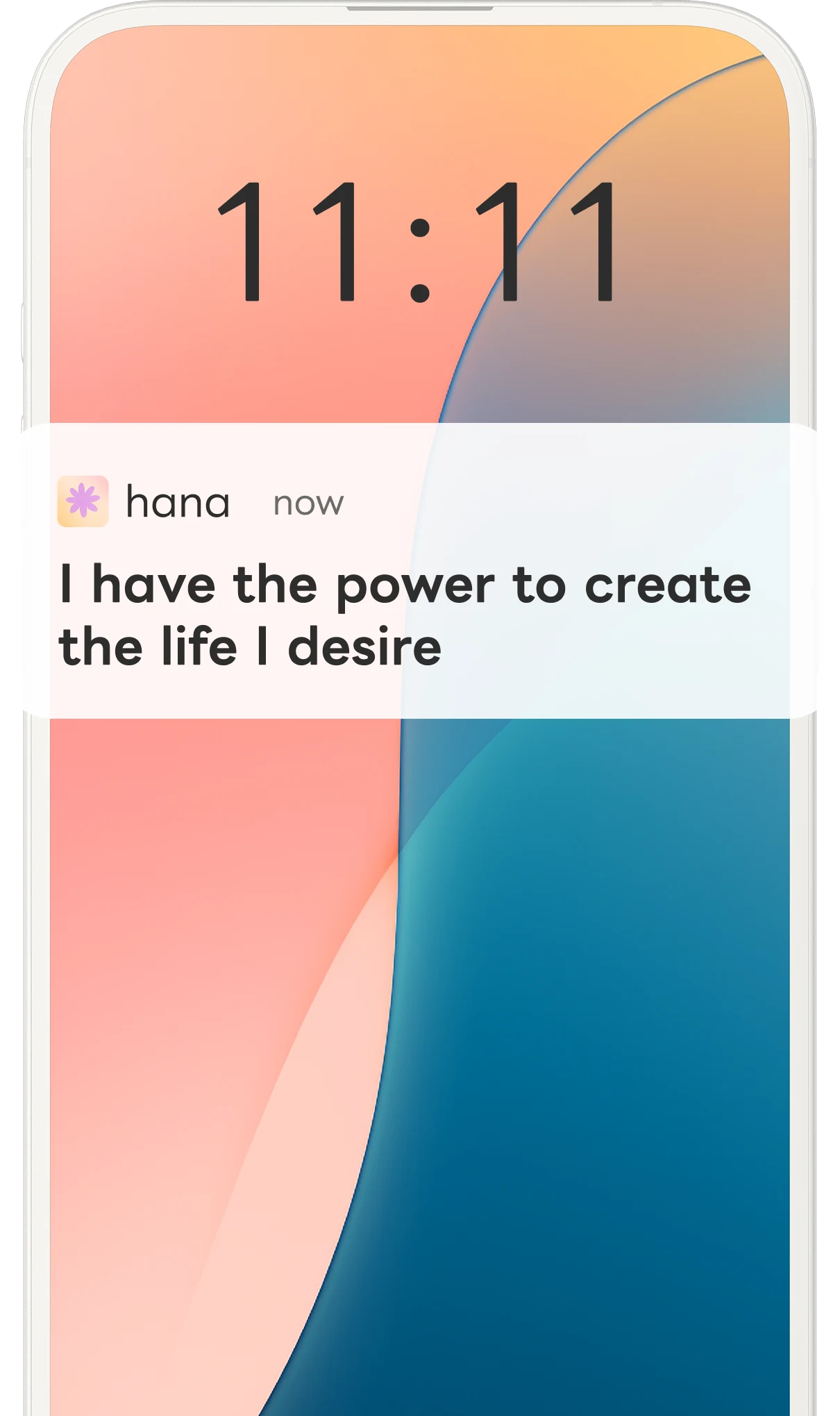
- Home screen widgets → Display illustrations and affirmations on your phone (constant positive reinforcement)
The science behind this loop is the RAS (Reticular Activating System), your brain receives roughly 11 million bits of sensory data per second, but your conscious mind can only process about 40-50 bits. The RAS decides what makes the cut.
When you repeatedly see your gratitude illustrations and affirmations throughout the day, your RAS recalibrates its filters to notice more things worth being grateful for. This isn't self-deception, it's training your brain to see more good.
Why Is 2026 the Best Time to Switch to an AI Gratitude Journal?
The Technology Has Hit a Sweet Spot
Between 2025 and 2026, AI image generation took a massive leap forward. Early AI art was riddled with uncanny details, six fingers, melting faces. Today, apps like hana produce stylistically consistent, warm, healing-quality personalized illustrations that you'd actually want as your phone wallpaper.
AI Has Evolved From Tool to Companion
In 2026, AI gratitude journals don't just passively record your text. They actively:
- Generate affirmations tailored to your current emotional state
- Track mood trends and surface hidden patterns
- Let you see gratitude journals written by people around the world in the Gratitude Universe public feed, and send each other hearts and comments
This represents a qualitative shift from "tool" to "companion."
Mental Health Awareness Continues to Rise
Global mental health awareness has surged throughout the 2020s. People are no longer satisfied with "I know journaling is good for me." They want concrete data. Visual feedback. Immediate support. AI gratitude journals deliver exactly that.
How Do You Choose the Right AI Gratitude Journal App?
It helps to start with a comparison of AI journal apps, then weigh these factors when evaluating AI gratitude journal apps:
- AI feature depth: Does it only analyze text, or can it generate personalized illustrations?
- Mood tracking: Does it offer mood logging with trend analytics?
- Personalization: Are affirmations generic or dynamically generated from your entries?
- Visual experience: Is the review interface engaging and beautiful?
- Community features: Can you share and interact with others?
- Privacy: Is your journal content securely protected?
If you're looking for an app that integrates all of the above, hana - Gratitude Journal is one of the few gratitude journal apps that combines personalized four-panel illustrations, mood tracking, smart affirmations, and community interaction in a single experience.
What Does the Future of AI Gratitude Journaling Look Like?
We're standing at a fascinating intersection, the convergence of AI technology and positive psychology is just getting started.
Here's where things are heading:
- Predictive emotional support: AI uses your historical data to anticipate when you might hit a low point, offering proactive encouragement
- Voice journaling: Skip typing entirely; speak your gratitude and AI converts it to text and images
- Multi-modal interaction: AR (augmented reality) integration that brings your gratitude illustrations into your physical space
- Cross-platform integration: AI journals sharing data with health apps, sleep trackers, and meditation tools
No matter where the technology goes, the core purpose remains unchanged: helping you see the good in your life and transforming that awareness into sustained positive energy.
Frequently asked questions
How is an AI gratitude journal different from a plain text journal?
The biggest difference is feedback. A text journal leaves you with words on a page, while an AI gratitude journal turns your entry into a personalized four-panel illustration, tracks your mood trends, and generates affirmations based on what you wrote that day. For anyone who struggles to stick with journaling, that instant visual feedback makes every entry feel more rewarding.
Why does pairing gratitude with an illustration help me remember it?
It comes down to Allan Paivio's Dual Coding Theory. When information is presented as both words and images, your brain builds two separate memory pathways, so retention is much higher than with text alone. Your gratitude stops being a single line of text and becomes a scene you can revisit.
Will AI-generated affirmations feel generic, like they are not really about me?
The point is to generate them from what you actually wrote that day rather than recycling lines like 'I am worthy.' If your entry mentions your boss recognizing your proposal, the affirmation ties back to that moment, which is what makes it resonate. It is anchored in your real experience, not a template.
Can a gratitude journal help with anxiety?
Shifting your attention from what might go wrong to what you already have can reduce anxious rumination, and mood tracking can show you that things are often better than they feel. That said, hana is a mental-wellbeing companion, not therapy or a medical service; if anxiety seriously affects your daily life, please seek professional support.
Keep reading
Best Gratitude Journal Apps with AI Features (2026 Comparison)
Compare 7 top gratitude journal apps by their AI features in 2026. From AI-generated art to smart affirmations, find your perfect AI gratitude app.

Manifestation Journal: The Complete Visual Guide (5 Steps)
Learn how to start a visual manifestation journal in 5 science-backed steps. Discover how the RAS system helps your brain attract the life you want.

The Power of Sharing: Why Sharing Your Gratitude Journal with Others Amplifies the Effects
Sharing your gratitude journal multiplies its effects. Discover why passing on your inner light creates emotional resonance, and how the Gratitude Universe makes gratitude feel seen and treasured.

Gratitude Universe: See the World's Gratitude and Never Journal Alone
Writing your gratitude journal but feeling alone? hana's Gratitude Universe is a feed of gratitude: share your own entries if you want, and see what people around the world are grateful for, sending hearts and comments so the practice never feels lonely.
Start your gratitude journal
One minute a day. hana turns your good things into your own illustration
Download hana free